You build a device that emits light. We tell you what it actually delivers, design the protocol that makes it work, prove it at whatever scale your file requires, and put it back inside your device. Since 2007 with the INM in Montpellier, that loop has run on our own products. It now runs on yours.
01 · What we do for you
Six ways in. Start with the one that sounds like you.
Each one starts from a sentence we have heard in a first meeting. The outcome is underneath it; the scientific justification opens on the card.
Which of these sounds like you?
If you already sell a device
“Our professional device is fixed, and it only sees the patient twice a month.”
Extend
Turn the device you have already sold into a subscription.
Your device stays exactly as it is. We characterise what it delivers, measure what the patient is missing between sessions, and establish the schedule that keeps the cumulative effect inside the window across the whole interval — at home, or on satellite units in the clinic.
Dose completionYour device characterised, the shortfall quantified, and a satellite configured to deliver the remainder on a schedule established for your device — not assumed from ours.
Protocol licensingWhere you have no protocols of your own, ours are licensed to you and adapted: to run on your device, on the satellite, or divided between the two.
Extend is for a company with hardware already in the field. Operate is for a company that wants the whole model built from nothing.
“Our device works, but we can't say what it delivers.”
01 Characterise
Find out what you are actually selling.
What you get
Full spectral and dosimetric characterisation of any light-based device, ISO-certified and automated, including photobiological safety qualification against IEC/EN 62471. The cheapest question you can ask us, and the one every later question depends on.
“We need phototoxicity data, and nobody measures the light.”
02 Prove it is safe under light
A safety result a regulator will actually accept.
What you get
Phototoxicity and photo-irritation assessment on human keratinocytes, fibroblasts or reconstructed human epidermis. The difference is not the assay, which any laboratory can run — it is that the light source is characterised and the delivered dose is known. A phototoxicity result obtained under an uncharacterised lamp tells you very little, and a regulator may say so.
“We need protocols we don't have.”
03 Formulate
Turn a light source into a product line.
What you get
A device with one mode is sold once. A device with a protocol library is sold, then subscribed to — the category analysts now track on its own, growing at 19.9% a year. New treatment protocols designed against a named mechanism, with the dose window mapped rather than assumed, the mechanism supported at gene and protein level where the claim requires it, and the whole thing matched to your hardware's real output.
Validate your photobiomodulation science and arrive with the evidence file already built.
What you get
Validation staged to the level you need, at any of the six scales, up to a clinical study with ethics-committee approval and registration. We scope it, write the protocol, place the work across the partner network, and deliver a single report against pre-agreed requirements. Also the route for confirming a proof of concept before you commit to a product.
“We need the device itself.”
05 Embody
Couple your technology to a device that is already certified, and reach markets you cannot enter alone.
What you get
Branding — our hardware under your name. Or OEM — your device carrying protocols developed for you and licensed to you exclusively. Registration is per device and per market, so joining a certified platform is not a transfer of certificate. What it removes is the blank sheet: the quality system, the technical file, the photobiological safety qualification and the clinical evidence already exist, and are maintained.
ISO 13485 · CE · FDA · Swissmedic · ANVISA — technology registered as a medical device in 15 countries.
“We need a different business model.”
06 Operate
Stop selling a box once.
What you get
Technology as a Service. The professional device, the protocol library, the patient's home device and the follow-up between sessions, sold as a subscription rather than a box. It is the model we run on our own products — thirty thousand users across fifteen countries — and the reason the loop has a seventh station.
02 · The problem
The field's problem was never the light. It was the dose.
Photobiomodulation works. It has worked in the literature for fifty years. What it has never had is a standard of care — and the reason is uncomfortable: most published work reports the light leaving the source, not the light reaching the cell. Two studies can use the same wavelength, the same stated irradiance and the same duration, and deliver doses that differ by a factor of seven. One works. One does not. Both are published. That is how a real effect ends up looking controversial.
Too little does nothing. Too much works against you.
The dose response is biphasic: there is a window, and outside it the effect flattens or reverses.
Huang & Hamblin, 2009.
7×
The gap between what you emit and what arrives.
In our own study the light nominally emitted was 11.3 mW/cm². The light actually reaching the neurons, once the optical profile and the culture medium were accounted for, was 83 mW/cm². A sevenfold gap, in a controlled bench experiment.
Burland et al., J. Biophotonics, 2015.
Still no standard.
A 2024 review of the whole dermatological field reached the same conclusion: protocols remain unstandardised and studies remain difficult to compare.
Hernández-Bule et al., Int. J. Mol. Sci., 2024.
The field just stopped being controversial. That is the problem.
Two international consensuses landed in three years — twenty-eight experts on photobiomodulation in supportive oncology, then a Delphi panel of twenty-one dermatologists. The question is no longer whether light works. It is whether your light works, at your dose. That question now has an audience that knows how to ask it.
Robijns et al., Frontiers in Oncology, 2022 · JAAD Delphi consensus, 2025.
And the market is accelerating.
+21.2%a yearLED and photorejuvenation — the fastest-moving slice of the marketPrecedence Research
+19.9%a yearAt-home device subscriptions, to $16.5B by 2036Future Market Insights
+14.2%a yearEnergy-based aesthetic devices, $9.5B to $27.7B by 2034Precedence Research
+9.8%a yearConsumer red light, $534M to $1.13B by 2033 — 59.5% of it cosmeticGrand View Research
If you sell a light device, this is your exposure — and your opening. A proof requirement is a cost to everyone who cannot meet it, and a position to everyone who can.
03 · The R&D loop
How a light source becomes a validated protocol.
Our device closes a loop continuously: emit, measure, adjust, until the dose prescribed is the dose delivered. Our research closes the same loop, one scale up, over years instead of milliseconds. It is the same discipline applied to the protocol rather than to the photon.
ACharacteriseAny light device, measured. Spectrum, irradiance, and the dose actually delivered.
BTargetName the mechanism to act on: which cell, which depth, which pathway.
CModelMap the dose response in vitro. Find the window where the effect is real.
DTranslateConfirm the window on an integrated model, before it reaches a person.
EProveClinical validation, by ethics committee or by a network of practitioners.
FDeployCompile the protocol into the device, so the validated dose can be delivered.
GLearnReal use, at home, returns data — and the next thing to measure.
03 · The R&D loop
Every turn narrows the window. It is why the dose you receive is the dose that was validated.
What comes out of the loop is not a better lamp. It is a file: a dose you can name, a protocol you own, and a claim you can print.
04 · The dose gap
Their device is not wrong. It is only there twice a month.
A professional device delivers a fixed dose, at intervals it cannot change. That is not a design flaw — it is what a clinic-based device is. But photobiomodulation works on cumulative exposure inside a window, and between visits the patient falls out of that window. The session was right. The month was not.
We do not propose replacing anything. We characterise the device you already sell, measure what it actually delivers, and establish the schedule that keeps the cumulative effect inside the window across the whole interval — then deliver the remainder on a satellite unit, at home or in the clinic.
This is a scheduling problem, not an addition. Cells retain a memory of prior exposure and respond more readily to the next one, so a course cannot be topped up by arithmetic. The schedule has to be established for your device, on your measured output. That is the work.
Between sessions, the cumulative effect falls below the window the protocol was validated in.
We characterise their device, measure the shortfall, and establish how the dose may be divided.SCHEMATIC — ILLUSTRATIVE, NOT MEASURED DATA. FRACTIONATION IS VALIDATED PER DEVICE, NOT ASSUMED.THESE CONTROLS ARE A CONCEPTUAL ILLUSTRATION, NOT A DOSE CALCULATOR. NO BIOLUX PARAMETER GOES IN OR COMES OUT, AND NOTHING HERE IS A RECOMMENDATION.
At home, the dose is not left to the patient.
The objection to home treatment is that the dose stops being controlled. Here it is the reverse. The physician prescribes the protocol and the schedule. The device runs it autonomously, and the patient cannot increase, extend or alter it. Every session is timestamped and recorded — what was delivered, when, and whether the course was completed — and the record returns to the prescribing physician.
ONE · PRESCRIBEDThe physician sets itThe protocol and the schedule are prescribed in the clinic, from the measured shortfall of their own device.
TWO · ENFORCEDThe device holds itLUXe runs the prescribed protocol autonomously. The patient cannot increase, extend or alter the dose.
THREE · LOGGEDThe session is recordedEvery session is timestamped and recorded — what was delivered, when, and whether it was completed.
RETURNED TO THE PRESCRIBING PHYSICIAN
A timestamped record of every session is a stronger form of oversight than a clinic can keep on its own. The physician keeps control between appointments.
The protocol improves while you sell it.
A protocol licensed from us is not a static document. Sessions delivered at home return what was delivered, when, whether the course was completed, and how quickly the response appeared. Where a cohort responds faster than the protocol assumed, that finding shapes the protocol issued to the next patients of the same profile. This is station 07 of our loop, opened to your installed base.
Prescribed by a physician.
Enforced by the device, not the patient.
Logged to the session.
Returned to the prescriber.
Refined for the next cohort.
No other device is built for this.
And it discharges an obligation you already carry.
Post-market clinical follow-up is a requirement under MDR, not an option. Most manufacturers meet it with questionnaires, registries and reconstruction after the fact. A continuous, timestamped record of real-world use, collected as a by-product of treatment, is the same obligation met automatically — and met better.
And the data is handled properly.
Two flows, two regimes. The session record that returns to the prescribing physician is patient data, held on a documented legal basis with the consent of the patient and the physician. What comes back to us for protocol refinement carries no link to a patient — delivery data only, at cohort level. The platform is built to keep those two apart.
And if you have no protocols, ours are licensable.
Thirty-two protocols, clinically validated and running on a device registered in fifteen countries, can be licensed and adapted: to run on your hardware, on the satellite, or split between the two once we know what each one delivers.
You keep your device, your clinics and your brand. The physician keeps the patient and the clinical control. What changes is that the treatment continues between visits — and that what happens between visits comes back.
05 · The proof behind it
Everything above rests on this.
Nothing here is a summary — these are the full chapters, closed so that they do not stand between you and what you came for. Each one says what is inside before you open it, and opening one does not close the others.
05.1CharacterisationWhat we measure when a device arrives, and what comes back in the report.
Bring us your device. We will tell you what it actually delivers.
Characterisation is the cheapest question you can ask us and usually the most informative. We measure emission spectrum, irradiance across the field, uniformity and delivered dose at working distance — not at the diode. The spectrophotometry is ISO-certified and the measurement chain is automated, which is why the turnaround sits inside a development cycle instead of interrupting it.
Most devices come back with a gap between the specification and the measurement. That gap is the conversation.
What you get
Emission spectrum and spectral purity, per source
Irradiance map and field uniformity
Delivered dose at real working distance
Photobiological safety qualification against IEC/EN 62471
A written report you can put in front of a regulator, a partner or a board
A specification you cannot measure is a claim you cannot make — and, increasingly, a claim someone will ask you to prove before they carry you.
05.2The platformThe instruments, the institute we have worked with since 2007, and the fifteen years behind them.
Instruments most people cannot build, on a bench most people cannot book.
Countries where LUXe technology is registered as a medical device
Biolux Research is a multidisciplinary team — physicists, chemists, biologists, clinicians — working since 2007 with the INM in Montpellier, an institute of around two hundred researchers in neuroscience whose work spans vision, hearing, motor function, neuroplasticity, neurodegeneration, somesthesia and myelin. The partnership runs under an exclusive contract covering photomodulation protocol know-how and the expression of results by its teams, and gives us privileged access to its cellular imaging platform, ISO 9001 certified and IBISA accredited, part of the Montpellier Rio Imaging network.
We scope the study, write the protocol, place the work across the platform, and deliver one report against pre-agreed requirements.
Access to a bench is not the rare part.
Building the instrument is. To test a parameter rather than observe an effect, the light source has to be engineered into the experiment itself. Over fifteen years we have built stimulation rigs onto the instruments that matter, and they now sit on that platform in daily use by its researchers.
AInto the optical pathLight injected into the microscope's own beam path, so the illuminated spot can be sized and positioned onto a single cell — or onto one part of one cell.
BAcross a fieldA fibre-coupled source lighting a field wide enough to hold several cells at once, so their activity can be recorded together, under one known dose, with unlit neighbours as control.
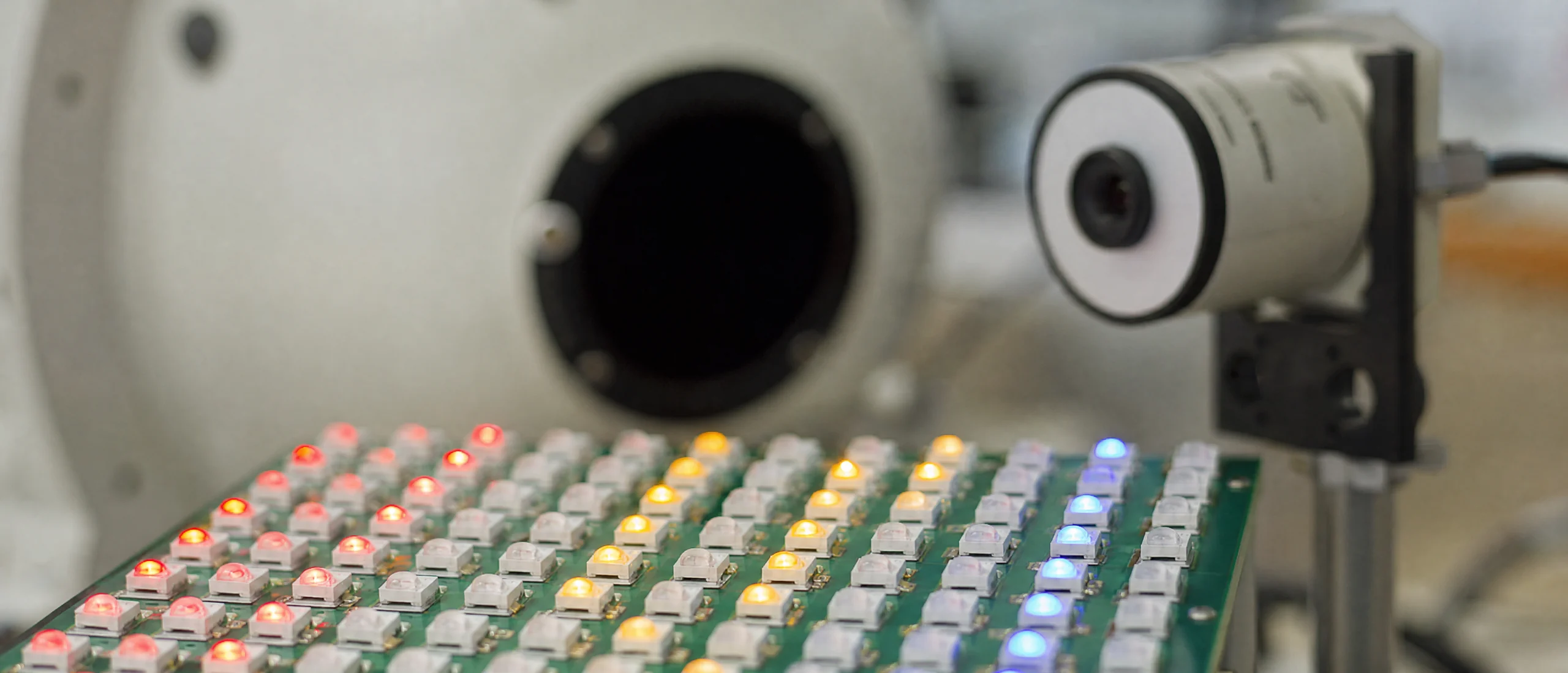
CMany doses at onceAn LED array addressing every well of a plate independently, each at its own dose, with optical isolation between wells. This is how a dose-response curve gets built in one run.
Research partnership since 2007. Imaging platform ISO 9001 certified and IBISA accredited.
Fifteen years, an institute of two hundred researchers, and instruments that are not sold anywhere. That is the cost of the alternative, and the honest reason to rent this rather than build it.
05.3Six scalesThe same dose, asked six different questions — from gene to patient.
The same dose, asked six different questions.
Stations 02 to 05 of the loop are not one activity. They are six, at six scales, and which one you need depends on what you have to defend: a marketing claim, a regulatory file, a proof of concept, or an investor.
GeneWhat did the cell intend to do?This is the scale that supports a mechanism-of-action claim rather than an observation.Methods
ProteinWhat did it actually make?An expressed gene is not yet a protein. This is where you find out whether it became one.Methods
Multiplex proteomics, up to ~3,000 proteins
Cytokine, ECM and barrier-protein panels
Low sample volume
CellDid it behave differently, and safely?Efficacy and safety are read at the same scale, in the same culture.Methods
Proliferation, migration
Live-cell time lapse
Calcium imaging
Viability, oxidative stress, phototoxicity
TissueDid the structure change, and at what depth?Quantified, not described — cell counts, epidermal thickness, staining thickness, interdigitation index.Methods
Ex vivo human skin
Histology & immunofluorescence
Confocal, two-photon, whole-slide scanning
ModelDoes it hold once the whole system is involved?The transition before anything reaches a person.Methods
3D reconstructed human epidermis
Preclinical models
Electrophysiology
Functional outcome
PersonDoes the patient notice, and can it be measured?The only scale at which the word clinical is yours to use.Methods
Registered clinical trial
Validated scar and pain scales
Profilometry, biopsy, cytokine assay
Increasing scale — decreasing control
A result at one scale is a hypothesis at the next. We do not present a cell result as a clinical claim, and we will tell you which scale your evidence currently sits at — and what the next one would cost.
Evidence is bought at the scale the decision requires. Paying for the wrong scale is the most common way this budget is wasted — a clinical trial to support a marketing claim, or a cell assay to support a regulatory file.
05.4Cross-validationWhy three independent readouts have to agree before anyone says a claim.
One readout is a finding. Three that agree is a claim.
The reason most efficacy claims in this market are weak is that they rest on a single measurement. We run three, and they check each other. Transcriptomics says what the cell intended to do. Proteomics says what it actually made, because an expressed gene is not yet a protein. Immunofluorescence and confocal microscopy say where it ended up, putting the molecular signature back into the tissue architecture it came from.
Readout oneTranscriptomicsWhat the cell intended to do.Which genes the dose switched on or off, across thousands at once — or cell by cell.Confirmed by ↓
Readout twoProteomicsWhat it actually made.Because an expressed gene is not yet a protein. Multiplex panels down to low-abundance mediators.Located by ↓
Readout threeImagingWhere it ended up.Immunofluorescence and confocal microscopy put the molecular signature back into the tissue.
A claim you can defend.
Three independent methods agreeing on one mechanism is the difference between an effect you observed and an effect you can put in a regulatory file.
One readout is cheaper. Until it is refused.
05.5The evidenceThree levels of proof, and the honest limit of each.
Three levels of proof, and we will tell you which one you're getting.
Tier 1 — Mechanism, peer-reviewed
Adult sensory neurons irradiated at 645 nm grew at 42.8 µm/h against 25.5 µm/h in control. On neurons with a prior nerve injury, already regenerating quickly, the rate rose from 52.0 to 80.8 µm/h — to our knowledge the fastest regrowth reported on a homogeneous substrate at the time of publication.
Burland et al., J. Biophotonics, 2015.
Tier 2 — Clinical, registered, ethics-approved
A double-blinded controlled trial on post-abdominoplasty scars, each patient serving as her own control, one side treated over ten sessions. At one and six months, scar quality was significantly better on the treated side on every scale used — Vancouver Scar Scale, and both the observer and patient halves of POSAS (p<0.05) — confirmed by software measurement of scar area. No side effects were reported.
Ramos et al., Aesthetic Plastic Surgery, 2019 · RBR-49PK78.
And the part most companies would cut: at twelve months, patients could no longer tell the two sides apart. The effect is on the early stages of healing. We say so, because a claim that outruns its data is a liability you inherit, not an asset you buy.
Tier 3 — Practitioner network
Qualitative case series on already-homologated protocols, gathered through a network of dermatologists, surgeons, physiotherapists and aesthetic practitioners. Useful, real-world, and clearly labelled as what it is.
We would rather under-claim and over-deliver.
06 · Starting
Send us the device, or send us the problem.
Step 1Tell us what you have.A device, a protocol, a claim you need to defend, or only an intention. One email.
Step 2We scope it in writing.A feasibility review across the partner network, then precise study protocols, costs, timeline and contracts — including what we think you should not do. Before any commitment.
Step 3We start with the measurement.Almost every engagement begins with characterisation, because almost every later question depends on the answer.